

 Dec 22, 2025
 3 min read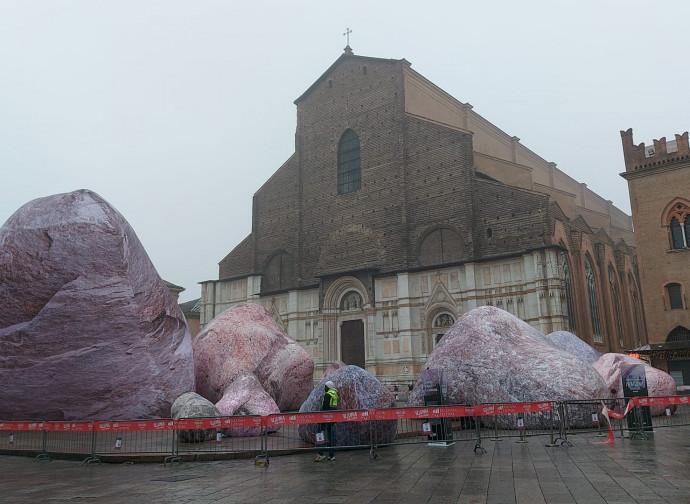
Bolognese Christmas balloons
Listen to the audio version of the story
Stone-shaped balloons in Piazza Maggiore in Bologna.Christmas is just an excuse, in fact the artist is not interested in anything.But the municipality of Bologna makes us believe so.The result, no matter which angle you look at the square, is one result: Christmas is thrown out of the Bolognese living room.
There's no reason to miss it: from whichever side of Piazza Maggiore you look at them, the inflatable megaliths housed in Bologna's "Crescentone" look more like coprolites than colossal stones, creating a sense of disparity.Of course, copromegalites, the remains of feces, were found in the nearby Villanova neighborhood and are displayed in the museum under the portico of the Pavglione.
They certainly have nothing to do with Christmas.The meager connection to the birth of Jesus placed on the totem, one must have the strength to read — and Kombasset read while rolling his eyes — further mocks the municipality's Christmas drive.For one very simple reason: the Australian artist who blew them away in the living room as Lucio Talla sang didn't care about Christmas himself.
At the moment, there is a misplaced enthusiasm from those who say that the installations will attract many tourists to the center; so the Bolognese bishop, as the local press expected, will have easy access to visit the Basilica of San Petronio. It is thought that the idea of art is still stuck in the ideas of breaking molds, breaking molds and, if possible, desecrating the sacred.
In fact, why is it necessary to burn a lot of plastic at Christmas?It is clear that the situation of births in Piazza Maggiore is not very good.Therefore, everything is considered, and despite the inauguration with great fanfare yesterday afternoon (and the inaugurations of insipid and incomprehensible installations have become the new thermometer of the decadence of this urban society), for this reason: Christmas in Bologna will have as its mark the Basilica of San Petronio covered with mega plastic inflatables that should represent the misery of this idea of creativity. this made it return to the beginning of the poverty of primordial thought anddeception.
The artist - artist is a term today devoid of any meaning given to someone who achieves some extension to be able to exhibit "anything" in a public or private space - his name is Nimrod Weis and he works for the Australian studio Eness.Does anyone know what this is?No, but as it is more than 3,000 km from our home, it is good to imagine that it is extraordinary, yet another concession to the provincialism of a balloon city that aspires with flights of fantasy to the highest levels and then in the showcase on Via delle Pescherie Vecchi offers as always tortellini cakes and the birth of nature. The nature of Bologna has always rhymed with work, reproduction and agriculture.
But the work is called "Iwagumi", which means "excess" in Japanese, it was gifted to the city by the Illumia and Bologna Festival and with the inauguration last night you can finally visit it by walking around and enjoying the lights and music of the sponsors.That's all.And the surplus?But it is explained in the totem at the entrance: "Nature, Christmas and excess. Remember that excess means putting the foundations in a humble attitude and remembering a sense of brotherhood instead of nurturing a sense of power over other people".The usual moralism brother - because the communists have always cultivated the feeling of social guilt very well, it is better than the church - the viewer should think about nature, which is immeasurable like these stones and therefore man is nothing, because nature is much bigger, it dominates him, it has him.
When this agreement for new and old changes, which makes people not at the end of the creation, but increasingly on the fringes, we move to the last line to clearly see Christmas.
So: “Offering this experience during the Christmas period aims to highlight that our culture is imbued with the history and signs of the immeasurable event of Christmas.The birth of God, who laughs like a child who has become a travel companion, is an event that destroys every dimension, that recounts the path of human life and its destiny."
Nice words, of course, but it applies to any vaguely Christmas complaint and not necessarily to these works that were born for something completely different, as the creator said in an interview with Carlino: "I've always had a great feeling in Japan, since I was twenty years old and I took my first important trip. I really liked the culture and everything from an environmental point of view to the people and the environment."In short: there's nothing Christmassy about it, so the projects have already been shown to other Australians, apparently with little interest.
Christmas is fake to justify everything, but when we think about it, Christmas is the opposite of superiority, at least if we think of the humility it represents, a little kid to put in a warm hut and make room for extra balls.
Nothing reminds us of that, nothing makes us think that somewhere the viewer has to consider the immensity of being a child of God because the works are lost in these big empty bubbles.Because no one would think of associating a plastic megalith with the humblest and mightiest birth in history.But the Communists of the Palazzo d'Acursio don't want to hear it;"Crescentone" rained, if we like, not quite neutrally, but a clear attempt to push the Bolognese Christmas out of their living room.